
This page contains affiliate links. If you buy through them, we may earn a commission at no additional cost to you. Read our affiliate disclosure.
Mosquitoes don't respond to one type of product, because they don't have one life stage. Larvae live in standing water, adults rest in shade and fly in on the breeze at dusk, and no single spray, trap, or repeller handles all of it. The six products below cover the main approaches homeowners actually use — spatial repellents, barrier sprays, larvicides, mechanical traps, and personal repellents — so you can build a setup that fits your yard instead of buying whatever is first in the search results.
- Thermacell E90 Rechargeable Repeller — Best Overall / Best Spatial Repellent
- Summit Mosquito Dunks — Best for Standing Water
- Cutter Backyard Bug Control Spray Concentrate — Best Barrier Spray
- DynaTrap DT2000XL — Best Chemical-Free Trap
- Mosquito Bits — Best Fast-Acting Larvicide
- Off! Deep Woods — Best Personal Repellent
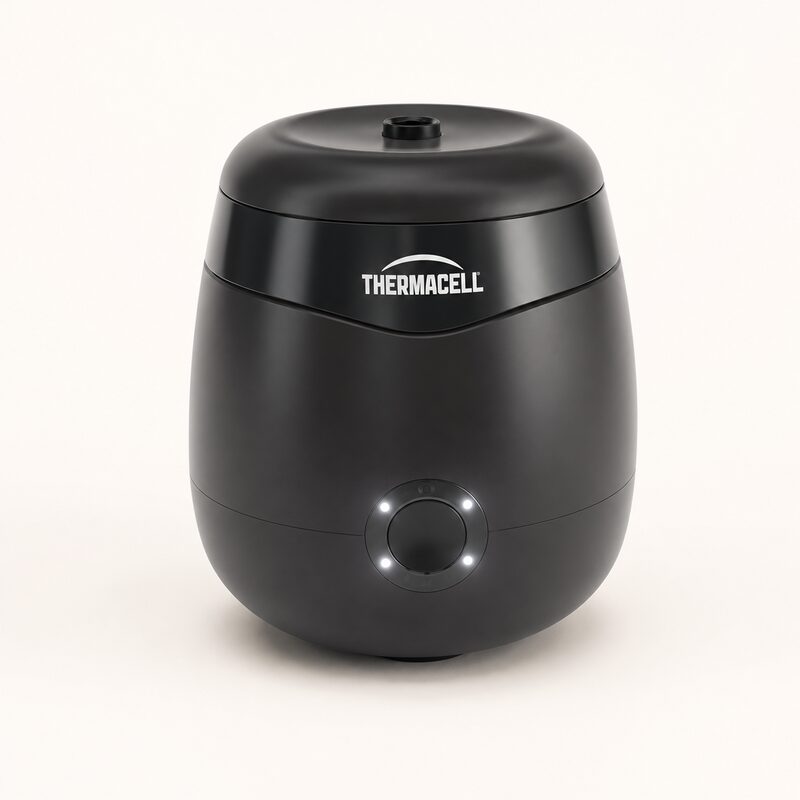
Thermacell E90 Rechargeable Repeller
The E90 is a spatial repellent, not a spray or a trap. A rechargeable battery heats a repellent mat treated with metofluthrin, a synthetic version of a compound found in chrysanthemums, and the heat releases it into the air around you rather than onto your skin. Thermacell rates the E90 for roughly 110 square feet of "zone" coverage in still air, which is patio-sized rather than yard-wide, and it works best in a spot without much wind carrying the vapor away.
It's EPA-registered, has no open flame, and doesn't leave a scent most people notice. A charge runs for hours before you need to swap in a new repellent cartridge, and refills are sold separately, so ongoing cost is a real factor beyond the roughly $40–$50 unit price. It's built for the space you're actually sitting in — a deck, patio, or fire pit area — not for suppressing mosquitoes across an open lawn.
Pros: No spray on skin or surfaces, quiet, effective in a defined sitting area, EPA-registered active ingredient.
Cons: Loses effectiveness in wind or open air; coverage is a zone, not a whole yard; refill cartridges are an ongoing cost; not a substitute for source control.
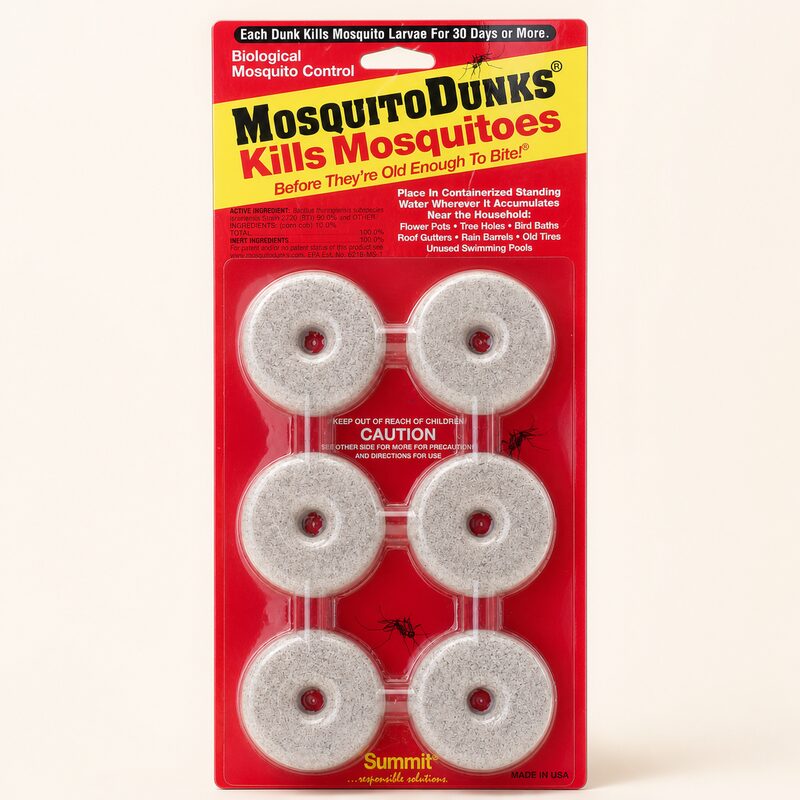
Summit Mosquito Dunks
Mosquito Dunks are a larvicide, not a repellent — they kill mosquito larvae before they ever become flying adults. Each donut-shaped dunk contains Bacillus thuringiensis israelensis (Bti), a naturally occurring bacterium that's toxic to mosquito and blackfly larvae specifically and is not labeled as harmful to fish, birds, pets, or people when used as directed. One dunk treats roughly 100 square feet of water surface and keeps working for about 30 days as it slowly dissolves.
These are meant for water you can't or don't want to drain: rain barrels, bird baths, ornamental ponds, low spots that hold water after rain, or unused pools. A pack of 20 typically runs around $10–$15. Dunks don't do anything for adult mosquitoes already flying around your yard, so they work best paired with a barrier spray or repellent rather than as a standalone fix.
Pros: Attacks the source instead of adults, Bti has a strong non-target safety record on the label, cheap per treatment, OMRI-listed for organic use.
Cons: Does nothing for adult mosquitoes already present; only useful if you have identifiable standing water; needs re-application roughly monthly through the season.
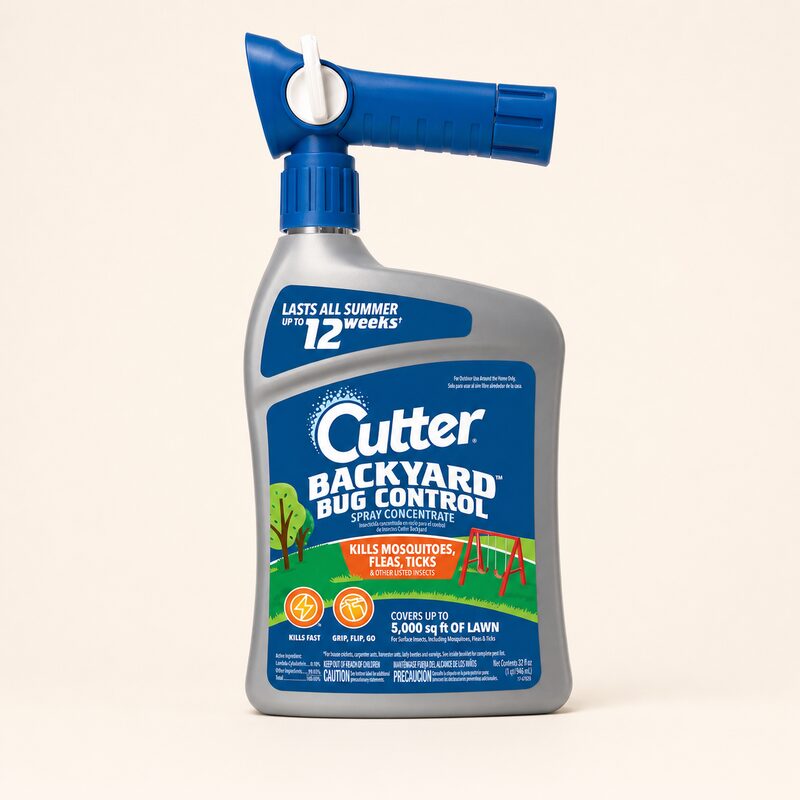
Cutter Backyard Bug Control Spray Concentrate
This is a barrier spray: bifenthrin-based concentrate you mix into a hose-end sprayer and apply to lawn edges, shrubs, mulch beds, and shaded resting spots where adult mosquitoes hide during the day. Unlike a larvicide, it targets adult mosquitoes (and ants, fleas, and ticks) on contact and leaves a residual barrier on treated foliage and surfaces. One 32-ounce concentrate bottle treats several thousand square feet and costs roughly $15–$20, making it one of the cheaper ways to treat a whole yard rather than just a sitting area.
Bifenthrin is a pyrethroid, and like other pyrethroids the label warns it's toxic to bees and other pollinators if applied to blooming plants, and toxic to fish and aquatic invertebrates if it runs off into ponds or streams. The label also generally advises keeping kids and pets off treated grass until the spray has dried. Read the specific label on the bottle you buy for reentry times and application limits — they can change between product revisions.
Pros: Treats the whole yard rather than one zone, residual effect between applications, inexpensive per treatment, also targets ants, fleas, and ticks.
Cons: Pyrethroid label carries pollinator and aquatic toxicity warnings, requires hose-end sprayer and mixing, needs periodic reapplication as it breaks down with UV and rain, not something to spray on flowering plants bees are visiting.
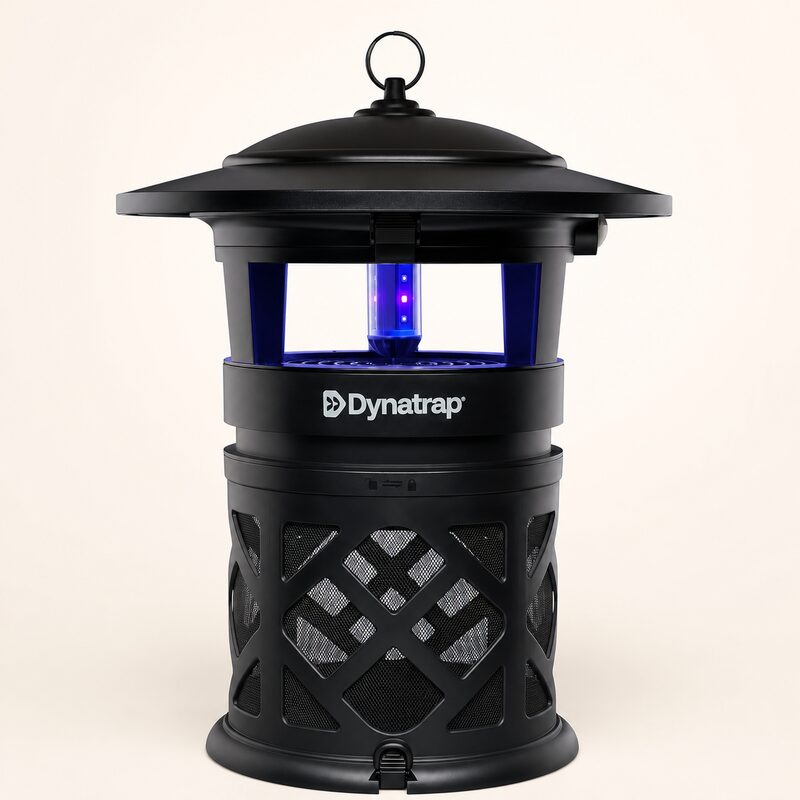
DynaTrap DT2000XL
The DT2000XL is a mechanical trap, not a chemical treatment. It uses UV light and heat to mimic the carbon dioxide and warmth of a host, drawing mosquitoes and other flying insects toward it, then a quiet fan pulls them into a cage where they dehydrate. DynaTrap markets the DT2000XL for up to roughly one acre of coverage, though real-world effectiveness depends heavily on placement — it works by luring insects in, so putting it near where people sit can actually draw more mosquitoes toward that spot rather than away from it. It's typically priced around $70–$100.
Because there's no spray, no scent, and no zapping sound, it's a reasonable option for households that want to avoid pesticides in the yard entirely. It runs continuously (best left plugged in 24/7 rather than switched on only at dusk) and needs the collection tray emptied periodically. It won't do anything about larvae already breeding in standing water, and it isn't a substitute for a repellent when you're sitting within a few feet of where people gather.
Pros: No pesticides or repellent chemicals, silent operation, covers a large outdoor area, low ongoing cost after purchase.
Cons: Placement matters a lot — too close to seating can pull mosquitoes toward people; upfront cost is higher than sprays or dunks; needs continuous power and periodic cleaning; doesn't address larvae.
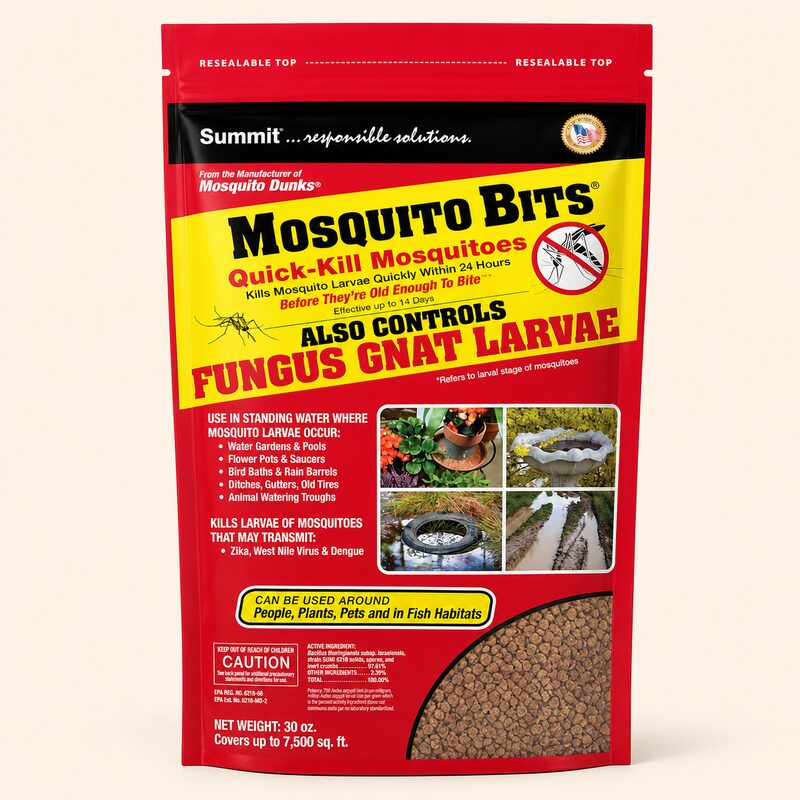
Mosquito Bits
Mosquito Bits use the same active ingredient as Mosquito Dunks — Bti — but in a granular form designed to release faster, working within about 24 hours rather than dissolving slowly over weeks. That makes Bits a better fit for temporary standing water: puddles after a storm, wet spots in mulch beds, gutters, or containers that fill and drain unpredictably, where you need larvicide activity quickly rather than a month-long slow release.
They're applied by sprinkling directly onto the water surface or into soil that holds moisture, and a bag typically covers a season's worth of spot treatments for around $15–$20. Like Dunks, Bits are labeled as low-risk to fish, birds, and pets used as directed, but they only affect larvae, so they need to be paired with something else if adult mosquitoes are already the problem.
Pros: Faster knockdown of larvae than dunks, good for unpredictable wet spots, same favorable non-target safety profile as Bti products, inexpensive.
Cons: Shorter-lasting than dunks so needs more frequent reapplication in persistent water, does nothing for adult mosquitoes, requires you to actually find the wet spots to treat.
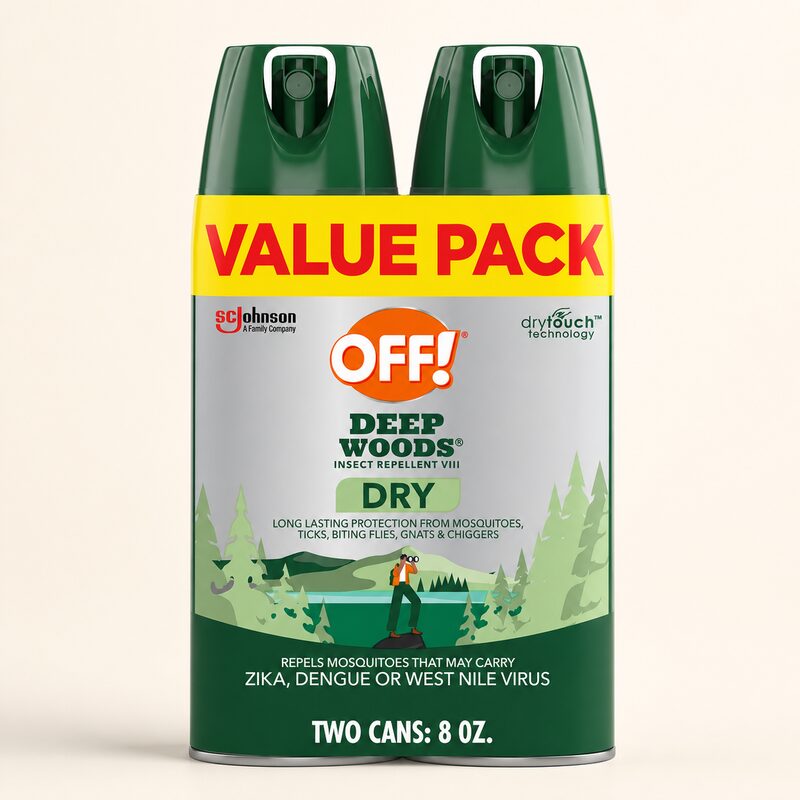
Off! Deep Woods
Everything else on this list treats the yard. Off! Deep Woods treats you. It's a DEET-based personal repellent, typically in the 25–30% concentration range depending on the specific formula, applied directly to exposed skin and clothing rather than sprayed on the lawn. The label states protection lasting several hours against mosquitoes, which makes it a practical backup for whoever is grilling, gardening, or otherwise moving around outside the zone a spatial repellent or trap is covering.
DEET products carry standard label cautions: avoid application under clothing, avoid broken skin, wash off after coming indoors, and use lower-concentration formulas for children per label directions (the CDC and EPA do not recommend DEET products on infants under two months old). A 4-ounce spray bottle usually costs around $6–$9. It's not a yard solution on its own, but it's the cheapest way to cover the gaps in whatever yard-wide approach you're using.
Pros: Immediate, portable, effective personal protection backed by decades of EPA-registered use, inexpensive.
Cons: Only protects the person wearing it, needs reapplication over several hours of exposure, DEET has label restrictions for young children, can degrade some plastics and synthetic fabrics on contact.
How to actually win against mosquitoes
Eliminate standing water first
Before buying anything, walk the yard after it rains and note anywhere water sits for more than a few days: clogged gutters, tarps, kiddie pools, plant saucers, tire ruts. A single bottle cap of water is enough for mosquitoes to breed in. Dumping, covering, or draining these spots removes the problem at its source and does more for long-term mosquito pressure than any spray. Where water can't be removed — a rain barrel or ornamental pond — that's where a larvicide like Mosquito Dunks or Mosquito Bits belongs.
Larvicides vs. adulticides
Larvicides (Dunks, Bits) stop mosquitoes before they hatch into biting adults; they do nothing about mosquitoes that are already flying. Adulticides — barrier sprays like the Cutter concentrate, or personal repellents like Off! — deal with mosquitoes that are already present. Neither approach alone solves the whole problem: a yard with no standing water but overgrown shade and tall grass can still be full of adult mosquitoes resting during the day, and a yard with a spotless lawn but an uncovered rain barrel can still breed its own supply.
Barrier sprays and pollinator caution
Pyrethroid barrier sprays are effective on contact and residual against mosquitoes, but the same broad-spectrum activity that kills mosquitoes also affects bees, other pollinators, and aquatic life if the spray drifts onto flowering plants or into water. Read the label for timing restrictions, avoid spraying blooms bees are actively visiting, and avoid application near ponds, streams, or drainage that leads to them.
Layering approaches beats relying on one product
The households with the fewest mosquito complaints usually aren't using one miracle product — they're removing standing water, treating water they can't remove with a larvicide, applying a barrier spray or running a trap to knock down resting adults, and keeping a personal repellent on hand for whoever's outside the treated zone. Each product on this list solves a different piece of the problem; none of them is a complete solution by itself.
When a professional service makes sense
If the yard borders woods, wetlands, or a neighbor's untreated property, or if DIY barrier spraying every few weeks isn't bringing numbers down, a licensed mosquito control service has access to different formulations, backpack and truck-mounted equipment for larger properties, and the ability to inspect for breeding sites a homeowner might miss. It costs more than a bottle of concentrate, but for a yard that backs up to consistent breeding habitat, it's often the more reliable long-term fix.
Frequently asked questions
Do spatial repellents like the Thermacell E90 actually work outdoors?
Within their rated zone and in relatively still air, yes — the EPA-registered active ingredient is designed to create a repellent cloud around a defined space. Wind, large open areas, and moving around outside that zone all reduce effectiveness, which is why it's positioned for patio and deck use rather than whole-yard coverage.
Are Bti-based products like Mosquito Dunks and Bits safe around pets and fish?
Their labels state Bti targets mosquito and blackfly larvae specifically and is not identified as a hazard to fish, birds, or pets when used as directed. As with any pesticide product, always follow the specific label instructions and application rates on the package you buy.
Can I use a barrier spray and a larvicide at the same time?
Yes — they target different life stages and don't conflict. Many yards use a larvicide in standing water alongside a barrier spray on shaded resting areas, since one without the other typically leaves a gap.
Is DEET safe for kids?
The CDC and EPA note that DEET repellents can be used on children per label directions, generally at lower concentrations, but advise against use on infants under two months old. Always check the specific product's label for age guidance and application instructions rather than assuming one product's rules apply to another.
Why do mosquito traps sometimes seem to make a yard worse?
Traps work by luring mosquitoes toward a light or CO2 source. If the trap is placed too close to a patio or seating area, it can draw more mosquitoes into that immediate vicinity before they reach the trap. Manufacturers generally recommend placing traps a meaningful distance away from where people gather, not right next to it.
Bottom line
No single product on this list eliminates mosquitoes on its own, because mosquitoes don't have a single point of attack. Start by removing standing water, treat what you can't remove with a larvicide like Summit Mosquito Dunks or Mosquito Bits, knock down resting adults with a barrier spray such as Cutter Backyard Bug Control or a trap like the DynaTrap DT2000XL, and keep a spatial repellent like the Thermacell E90 or a personal repellent like Off! Deep Woods on hand for the times and places the rest of the setup doesn't reach. Matched to the right job, each of these six products earns its place in a yard that's actually usable at dusk.
Our rankings and editorial scores consider product specifications, aggregated owner feedback, availability, drawbacks, and commercial relationships. Compensation may affect inclusion or ordering; scores are our own assessments and are not Amazon or customer ratings. Commercial relationships do not permit unsupported product claims. Read more about how we review.