
This page contains affiliate links. If you buy through them, we may earn a commission at no additional cost to you. Read our affiliate disclosure.
When a room stays stuffy no matter the thermostat setting, or the AC bill climbs just to cool one hot bedroom, a tower fan is usually the cheaper, faster fix. We compared airflow, noise, oscillation range, and owner reviews across six widely sold tower fans to help you find one that moves air at night without keeping you awake.
- Dreo Nomad One — Best Overall
- Lasko T42951 Wind Curve — Best Budget
- Vornado OSCR37 — Quietest
- Dyson TP07 Purifier Cool — Premium Pick
- Levoit Classic 36 — Best for Small Rooms
- Honeywell QuietSet Whole Room Tower Fan — Best for Bedrooms
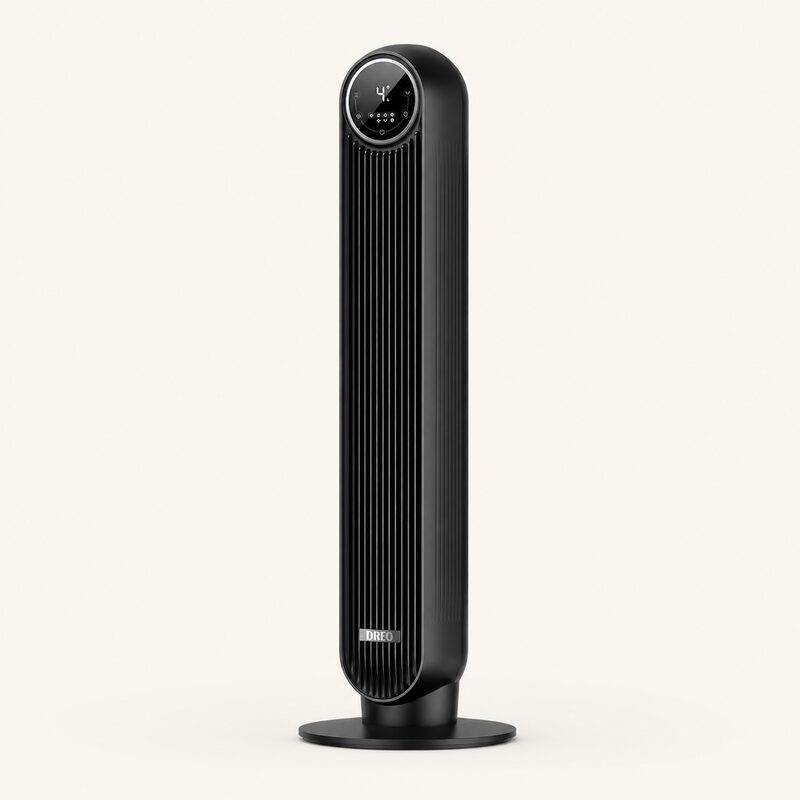
Dreo Nomad One
The Nomad One is a 42-inch tower fan with 90-degree oscillation and a claimed airflow rating around 2,900 CFM on its highest of 6 speeds — strong for this price class. It ships with a remote, an LED base display, and a sleep mode that dims the display at night.
Owner reviews praise how quiet it runs on low-to-mid speeds (around 30 dB), and the app-connected version adds Alexa and Google Home control. Typical price: $70–$100.
- Strong airflow for the price, especially on speeds 3–5
- Sleep mode dims the display and steps down speed automatically
- 8-hour timer and remote included at this price point
- Top speed is too loud for sleeping in the same room
- Some owners report the touch controls on the base becoming unresponsive after a year or more
- Wi-Fi/app version requires a stable 2.4GHz network and occasionally drops connection
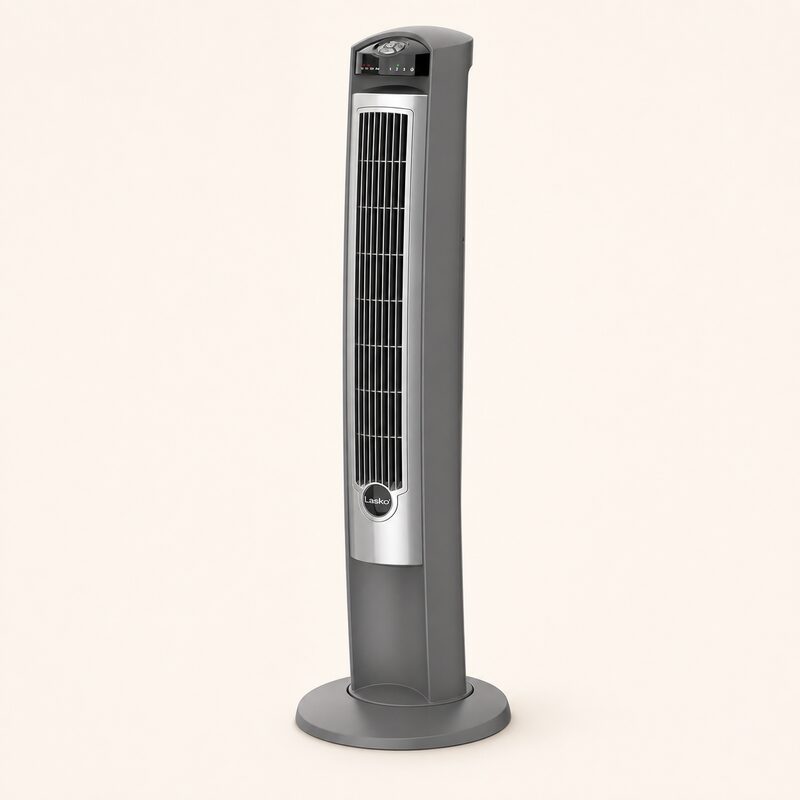
Lasko T42951 Wind Curve
Lasko's Wind Curve is a longtime bestseller. The T42951 adds a built-in ionizer, marketed as helping with airborne dust and odor, though that benefit is hard to verify independently. It's a 42-inch, three-speed fan with a curved cabinet meant to spread airflow wider than a straight column.
It comes with a remote, an 8-hour timer, and an ionizer switch you can leave off. At $45–$60 it's one of the cheapest name-brand towers available, with simple no-app setup. Owner reviews are mixed on longevity past 2–3 years, typical at this price.
- One of the lowest prices from a recognizable, established brand
- Simple, no-app operation with remote and timer included
- Widely available with easy-to-find replacement parts
- Only three speeds versus five or more on pricier models
- No oscillation lock position options beyond full sweep or stationary
- Some owners report motor hum or rattling after a year of regular use
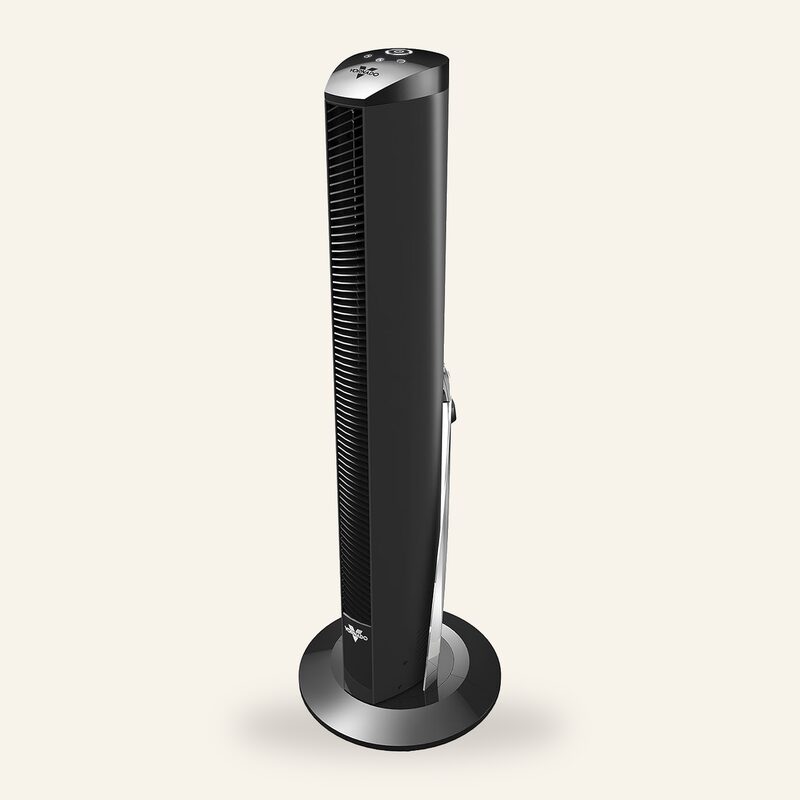
Vornado OSCR37
The OSCR37 is technically a tower air circulator, not a straight tower fan: Vornado's deep-pitch blades push a wider column of air that circulates a room instead of blowing a narrow stream at your face. At 37 inches, with 90-degree oscillation or a locked fixed-direction mode, it runs for hours without becoming background irritation.
Owner reviews and independent measurements consistently rank it among the quietest here on low and medium speeds, making it a common pick for bedrooms and home offices. It includes a remote, four speeds, and a timer. The tradeoff is price — roughly $130–$160, more than double a Lasko.
- Quietest fan in this roundup on low and medium speeds
- Deep-pitch blade circulates air across the whole room, not just toward one spot
- Sturdy build quality with a reputation for long service life
- Noticeably more expensive than standard tower fans
- Direct airflow at close range is weaker than a narrow-column tower fan on high
- Oscillation range tops out at 90 degrees, narrower than some competitors
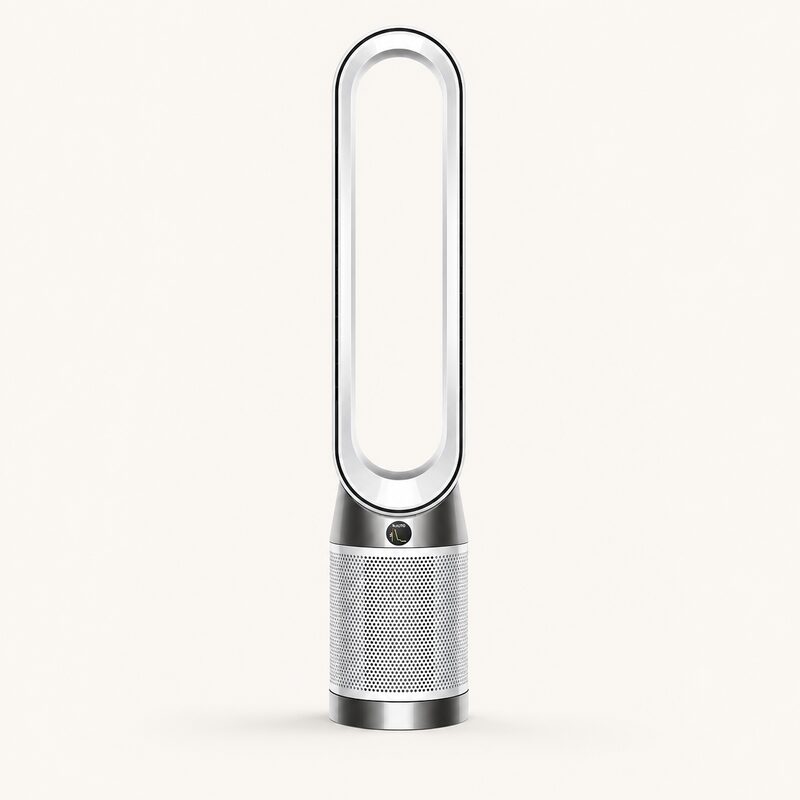
Dyson TP07 Purifier Cool
The TP07 pairs a bladeless tower fan with a HEPA H13 and activated carbon filter, using Dyson's Air Multiplier design to amplify airflow through a loop rather than exposed blades. It reports real-time PM2.5, VOC, and NO2 levels via LCD or the Dyson Link app, and oscillates up to 350 degrees — far wider than anything else here.
No exposed blades makes it safer around kids and pets. Owner reviews praise the app controls and filter reminders, but price is a real barrier: it runs $450–$550, plus $70+ in annual replacement filters. It only makes sense for buyers who specifically want purification bundled with cooling.
- HEPA filtration plus cooling in one unit, with real-time air quality readout
- No exposed blades — safer around kids and pets
- Widest oscillation range in this roundup at 350 degrees
- Significantly more expensive than every other fan on this list
- Annual filter replacement adds an ongoing cost most tower fans don't have
- Raw airflow (CFM) is lower than dedicated circulators like the Vornado at a similar price point
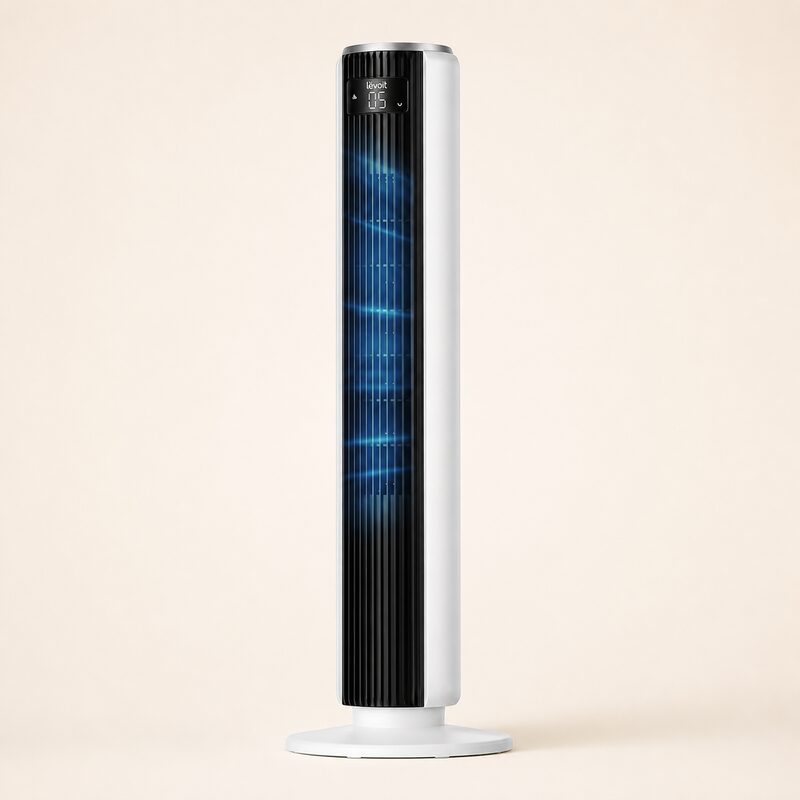
Levoit Classic 36
The Classic 36 is a compact tower fan that owner reviews describe as easy to tuck into a small bedroom, dorm, or office corner without dominating floor space. It has 3 speeds, 3 modes (normal, natural wind, sleep), 80-degree oscillation, and a remote with an 8-hour timer.
Levoit rates it around 25 dB on the lowest sleep setting, and owner reviews back that up, though it doesn't move as much air as larger 42-inch towers. At roughly $60–$80, it's built for cooling one person's immediate space rather than a whole living room.
- Small footprint fits tight bedrooms, dorms, and desks well
- Quiet sleep mode with dimmed display
- Simple remote and control panel, no app required
- Weaker overall airflow than 42-inch towers — not ideal for larger rooms
- Only 3 speeds limits fine-tuning
- Narrower 80-degree oscillation than most competitors here
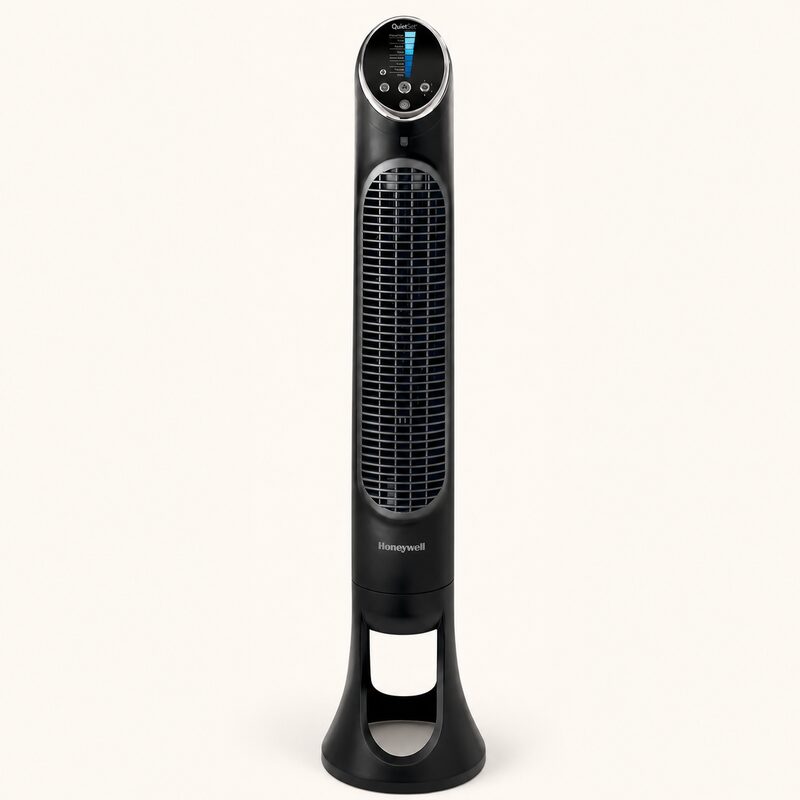
Honeywell QuietSet Whole Room Tower Fan
Honeywell's QuietSet line delivers exactly what the name promises: eight distinct speed settings, including a dedicated whisper-quiet mode, instead of the usual three or four. It's a 40-inch tower with 90-degree oscillation, a remote, and up to an 8-hour shutoff timer; the control panel doubles as a small LED indicator some owners find distracting at night.
Reported noise on the lowest setting is comparable to the Levoit and Dreo, and eight increments make it easier to land on a speed that cools without disrupting sleep. Price runs $50–$70, though the plastic housing feels less substantial than the Vornado or Dyson.
- Eight speed settings give finer control than most competitors' 3–4 speeds
- Dedicated whisper-quiet setting purpose-built for sleeping
- Affordable price relative to its speed-control granularity
- Control panel LED light can be distracting in a fully dark bedroom for some owners
- Build quality feels less sturdy than pricier options
- 90-degree oscillation is average, not class-leading
How to choose a tower fan
Tower fan vs. pedestal fan vs. air circulator
A tower fan's narrow cabinet takes up less floor space than a pedestal fan and typically oscillates over a wider arc. Pedestal fans push air harder in a direct line and angle up or down more easily, which matters more in a garage than a bedroom. Air circulators like the Vornado OSCR37 move and mix air throughout a room rather than blasting it at you — more even cooling, less dramatic up close.
The noise-vs-airflow tradeoff
Every fan here trades noise for airflow — more CFM generally means more motor noise. For overnight bedroom use, prioritize a quiet low-speed rating (25–32 dB) and a sleep mode, even at the cost of a weaker top speed. For daytime use where ambient noise is fine, raw CFM on the mid-to-high speeds matters more.
Room size and placement
Angle a tower fan to create cross-ventilation rather than pointing it straight at a wall or a stationary person. Rooms over roughly 300 square feet generally need a 40+ inch tower or a dedicated circulator; smaller rooms and dorms do fine with a compact 30–36 inch model like the Levoit Classic 36.
Features worth paying for
A remote and multi-hour timer are close to standard now and worth having regardless of price. A genuine sleep mode that steps down speed and dims the display is worth prioritizing for bedrooms. HEPA filtration (as on the Dyson TP07) is only worth the premium if purification is an actual goal, since it adds ongoing filter costs.
Frequently asked questions
Do tower fans actually cool a room, or just move air around?
Tower fans don't lower air temperature like an AC does — they move air across your skin, speeding evaporative cooling so a room feels a few degrees cooler than it is. They work best as a supplement to AC or as a standalone option where AC doesn't reach well.
How loud is too loud for a bedroom tower fan?
Most reviewers and manufacturers target 25–35 dB for the lowest usable speed, roughly the level of a quiet library. The Vornado OSCR37 and the lowest settings on the Dreo and Levoit land in that range; any fan on its highest speed will generally exceed comfortable sleeping noise levels.
Is a bladeless fan like the Dyson actually quieter or safer?
Bladeless fans are safer around kids and pets since there's no exposed blade, but they aren't automatically quieter — the amplifier design produces its own airflow noise, comparable to well-built bladed fans at similar output. The real reason to pay a premium for the TP07 is bundled purification, not quietness alone.
How often should I clean a tower fan, and does it affect performance?
Dust builds up on internal blades and intake grilles, and a dusty fan pushes less air while running louder. Wipe the exterior grille monthly during heavy summer use and do a deeper interior clean once or twice a season. Fans with washable pre-filters, like the Dyson, need that filter rinsed or replaced on the manual's recommended schedule.
Will a tower fan lower my electric bill compared to running the AC more?
Yes, meaningfully. A typical tower fan draws around 30–100 watts depending on speed, versus several thousand watts for central AC. Using a fan to raise the thermostat a few degrees, or to cool just one occupied room, is one of the cheapest ways to cut summer cooling costs.
Bottom line
For most households, the Dreo Nomad One offers the best mix of airflow, features, and price, and the Lasko T42951 is the reliable budget pick. Light sleepers should lean toward the Vornado OSCR37 or Honeywell QuietSet, while the Levoit Classic 36 fits tight spaces best. The Dyson TP07 only makes sense if air purification is a real priority alongside cooling.
Our rankings and editorial scores consider product specifications, aggregated owner feedback, availability, drawbacks, and commercial relationships. Compensation may affect inclusion or ordering; scores are our own assessments and are not Amazon or customer ratings. Commercial relationships do not permit unsupported product claims. Read more about how we review.