
This page contains affiliate links. If you buy through them, we may earn a commission at no additional cost to you. Read our affiliate disclosure.
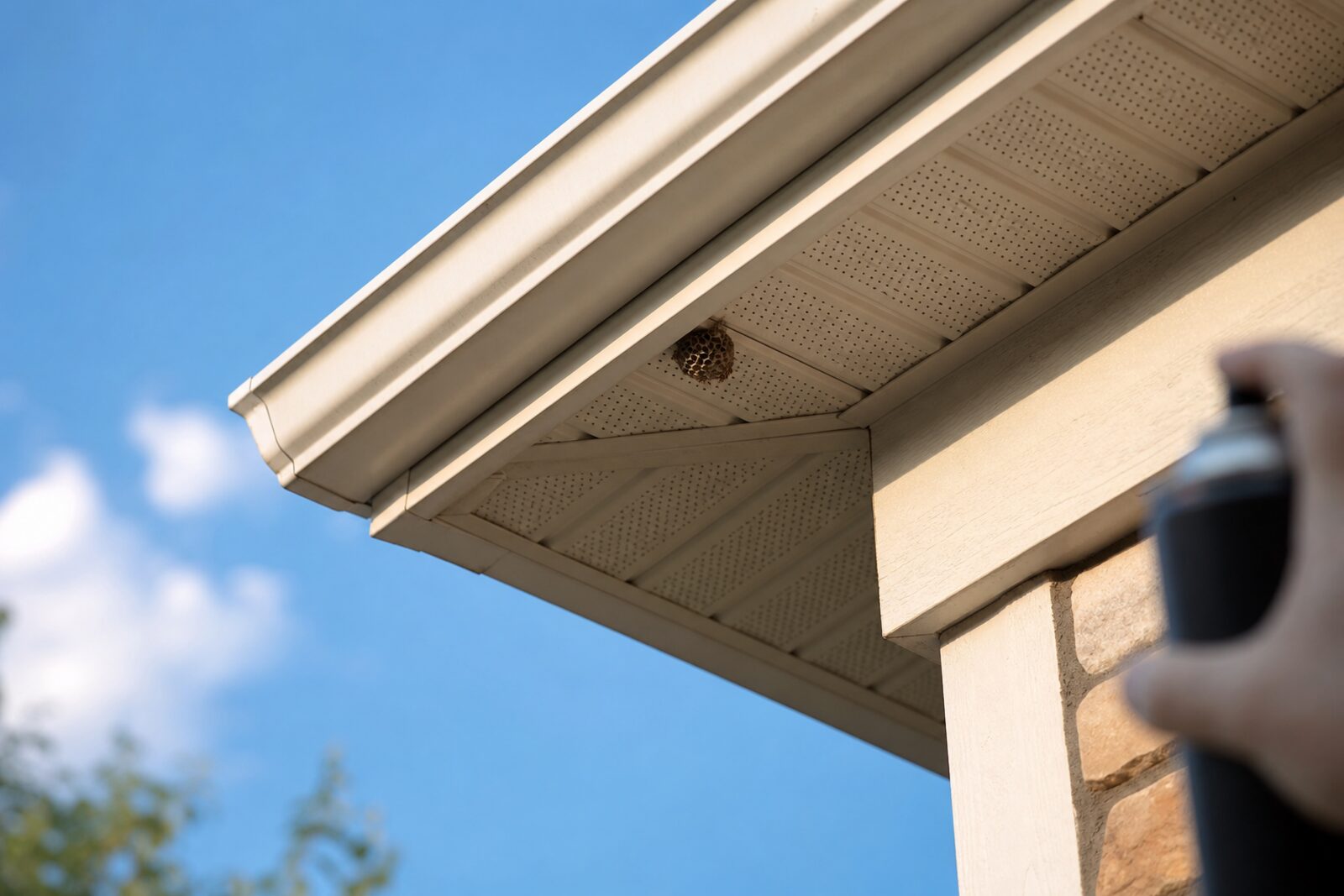
A nest tucked under the eaves or inside a deck rail isn't something to handle up close. The right spray lets you treat from a distance and retreat before the colony reacts, but "wasp and hornet spray" covers products with real differences — how far they reach, whether they foam onto the nest or shoot a thin stream into a crack, and whether they leave a residue that keeps working after the can is empty. This guide compares five widely sold options, what each is built for, and the label warnings that matter before spraying near a porch light, meter box, or soffit vent.
- Spectracide PRO Wasp & Hornet Killer — Best Overall
- Raid Wasp & Hornet Killer 33 — Longest Range
- Ortho Home Defense Hornet & Wasp Killer7 — Best Foaming Formula
- Hot Shot Wasp & Hornet Killer — Best Budget Pick
- EcoSmart Wasp & Hornet Killer — Plant-Based Option
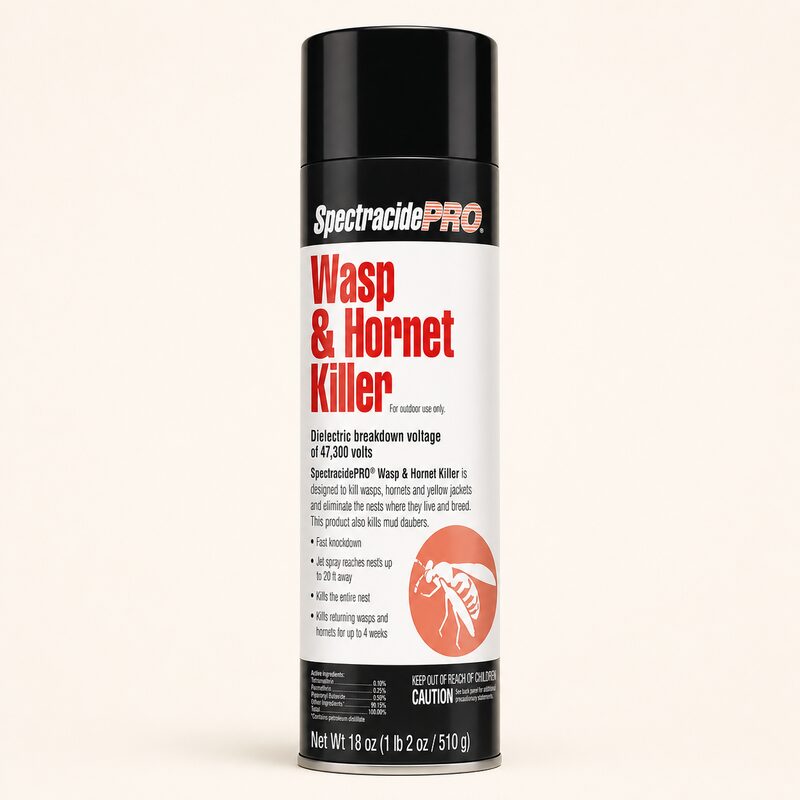
Spectracide PRO Wasp & Hornet Killer
An aerosol can, typically $6–$9, labeled to spray up to 20 feet — enough to treat a second-story eave nest from the ground on most homes. It uses a pyrethroid active (prallethrin and permethrin in current formulations) for fast knockdown, delivered as a stream rather than a foam.
The label cautions against spraying directly into outlets, meter boxes, or wiring, though it's rated for general outdoor structural use. Residual action holds up for about four weeks against wasps that were out foraging during treatment and return afterward.
- 20-foot range covers most eave and soffit nests from the ground
- About four weeks of residual knockdown on returning wasps
- Widely stocked at hardware stores and big-box retailers
- Stream formula runs off vertical siding faster than a foam would
- Strong odor on contact; ventilation matters if used near doors or windows
- Not labeled for nests inside wall voids
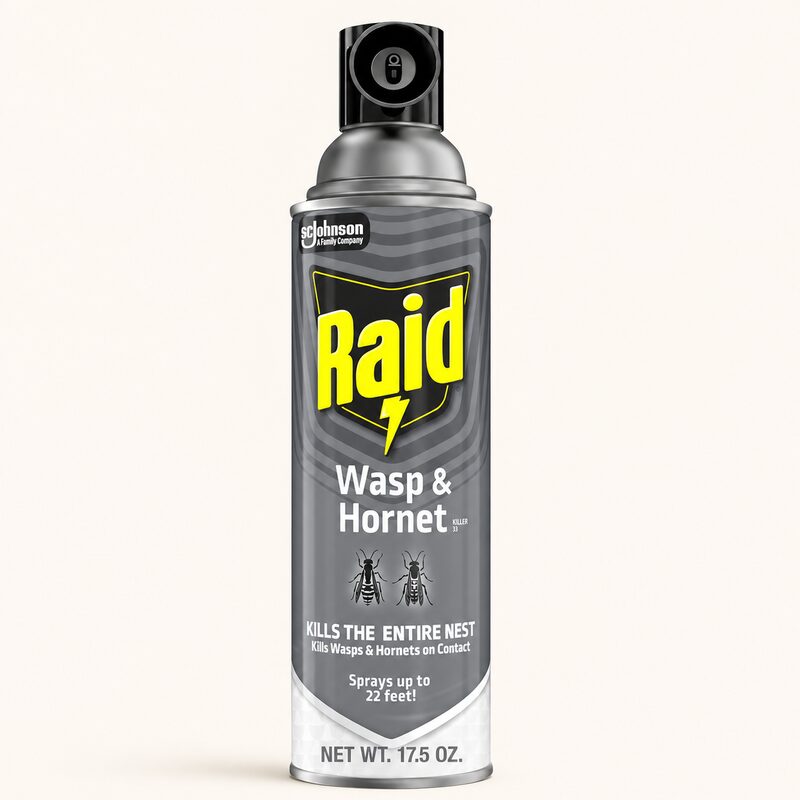
Raid Wasp & Hornet Killer 33
Raid's formula is labeled to reach up to 27 feet, among the longest ranges sold in a consumer aerosol, at roughly $6–$8 per can. It's a fast-knockdown stream that kills on contact within seconds, using tetramethrin and other pyrethroids.
That extra distance is the reason to reach for this one — a nest high under a roofline or across a deck stays treatable without closing the gap. The label warns against use near open flames and contact with electrical equipment. It's a knockdown product first, with less lingering residual than barrier-style sprays.
- 27-foot labeled range, longest of the group compared here
- Fast knockdown on contact, kills within seconds
- Widely available and inexpensive
- Less residual action than barrier-focused sprays
- Stream, not foam — harder to get full coverage on an irregular nest surface
- Flammable aerosol; keep away from grills, pilot lights, and open flame
Ortho Home Defense Hornet & Wasp Killer7
Priced around $7–$10, this one is built around a foam rather than a stream. The foam clings to the nest surface and expands into cracks, which matters for nests tucked into gaps around siding, gutters, or a deck rail where a stream would just run off. Labeled range is up to 20 feet.
Because the foam stays put, it's better suited to treating the nest opening directly than knocking down wasps in flight. The label pairs prallethrin for fast knockdown with a longer-residual pyrethroid, and carries the standard caution against spraying near electrical outlets or meter boxes. Best applied to the nest entrance at dusk.
- Foam clings to nest surfaces and fills gaps a stream would miss
- Good fit for nests recessed into siding, gutters, or rail gaps
- Dual fast-knockdown plus residual formula
- Shorter effective distance than Raid's stream when the nest is in the open
- Foam can be messier to clean off finished surfaces than a stream residue
- Not intended for open-air spraying at wasps in flight
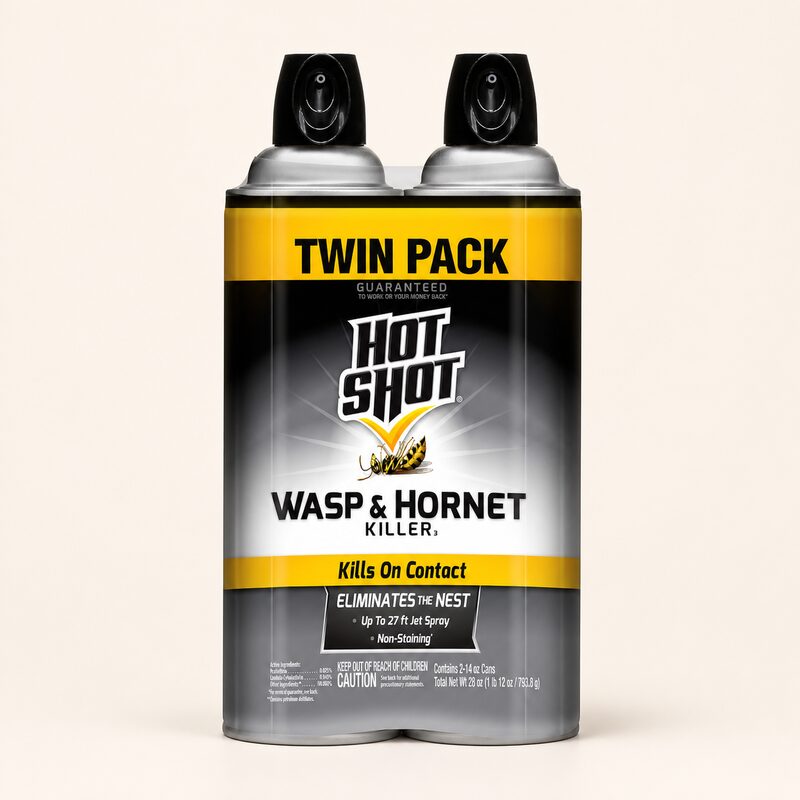
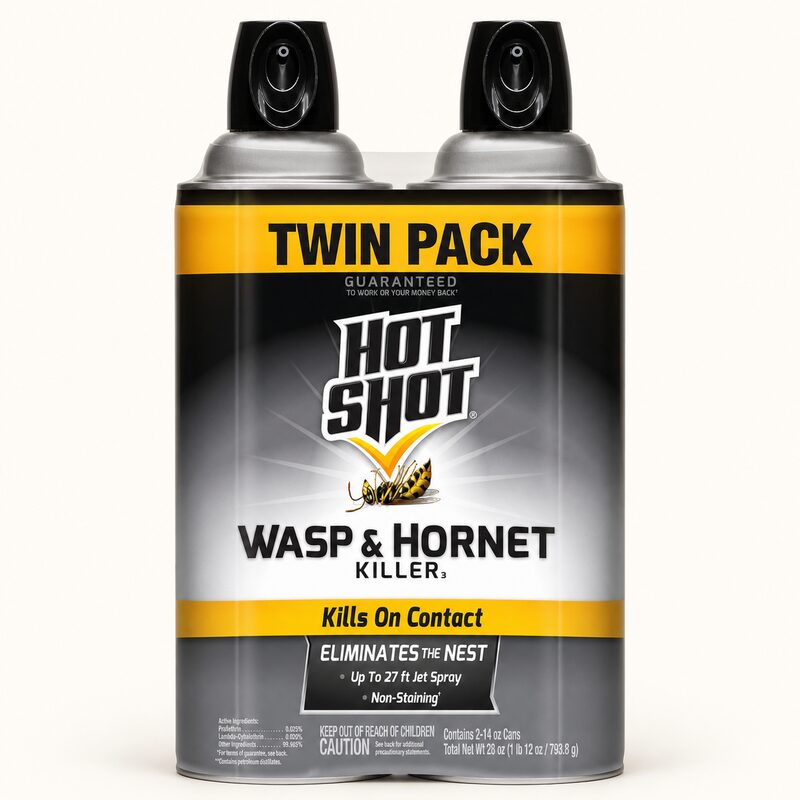
Hot Shot Wasp & Hornet Killer
The least expensive option here, around $4–$6 a can, with a labeled range up to 20 feet. It's a straightforward stream aerosol using pyrethroid actives for contact kill, without the foam or extended-residual claims of the pricier options.
It does the core job — knock down a nest from a safe distance — without extras, a reasonable pick for a single nest treated once rather than an ongoing perimeter product. Same cautions apply: avoid electrical fixtures, treat outdoors or in ventilated areas only.
- Lowest price point of the sprays compared here
- 20-foot range is adequate for most eave and deck-rail nests
- Simple stream delivery, no learning curve
- Shorter residual action than Spectracide PRO
- No foaming option for recessed or gapped nest locations
- Can requires closer proximity than Raid's 27-foot range on tall nests
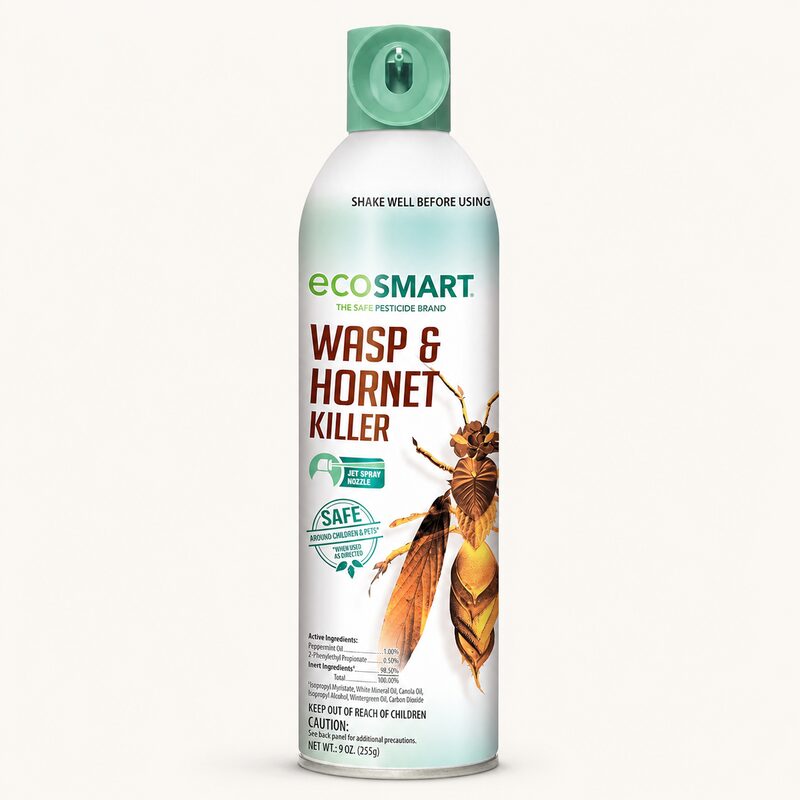
EcoSmart Wasp & Hornet Killer
Priced around $8–$12, this formula uses plant-based active ingredients — rosemary oil, peppermint oil, and 2-phenethyl propionate — instead of synthetic pyrethroids, for households wanting to avoid synthetic residue near a play area, garden, or pet-accessible deck. Labeled range is shorter, up to 15 feet.
Knockdown is fast on direct contact, similar to synthetic sprays, but the plant-based actives break down faster in sunlight and don't leave the multi-week residual barrier pyrethroid products do — expect to reapply if wasps rebuild nearby. The label still calls for standing back and treating at dusk; "natural" doesn't mean safe to spray at close range or breathe directly.
- No synthetic pyrethroids, appealing near gardens, play areas, or pet zones
- Fast knockdown on direct contact, comparable to synthetic sprays
- Pleasant scent relative to standard aerosol pesticides
- Shorter labeled range (15 feet) than every synthetic option here
- Residual action breaks down faster, especially in direct sun
- Still requires standard distance and ventilation precautions — not risk-free
How to take down a nest safely
Spray in the evening
Wasps and hornets are least active at dusk and after dark, when most of the colony is back in the nest. Spraying midday, when foragers are out and the colony is alert, is the most common reason a treatment turns into a chase. Use a red-filtered flashlight if you need to see the nest after dark — plain white light can trigger a defensive response.
Keep your distance and know your exit
Stand at the maximum labeled range, not the minimum, and identify a clear path behind you before spraying — wasps can fly faster than a person can back away. Treat the nest, then leave the area rather than watching for results; give it a full day before checking whether activity has stopped.
Paper wasps, yellowjackets, and bald-faced hornets aren't the same job
Paper wasps build open, umbrella-shaped nests under eaves and rails — usually the easiest to spot since the nest and entry point are the same thing. Yellowjackets are more aggressive in defense and often nest in the ground or inside wall voids. Bald-faced hornets build large, enclosed paper nests in trees or under overhangs and can be the most defensive of the three when disturbed. Confirm which one you're dealing with before treating.
Ground nests need a different approach
A ground nest, common with yellowjackets, should be treated at the entrance in low light, then left undisturbed — don't cover or fill it in — until activity has stopped over a couple of days. Mowing or digging nearby before the nest is confirmed dead is a common way ground nests get disturbed.
When this is a job for a pro
Call a licensed pest control company if anyone in the household has a known allergy to stinging insects, if the nest is large (a bald-faced hornet nest the size of a basketball, for example), if it's inside a wall void or soffit where spray can't reach the full colony, or if a first treatment doesn't stop activity within a day or two. A professional can also reach nests safely from ladders or tight spaces a homeowner shouldn't be treating solo.
Frequently asked questions
What's the difference between a foaming spray and a stream spray?
A stream travels farther in a straight line and is easier to aim at full label distance, but it can run off vertical surfaces. A foam clings to the nest and expands into gaps, better suited to nests recessed into siding, gutters, or rail joints.
Is it safe to spray a nest near a light fixture or electrical meter?
Most labels caution against spraying directly onto electrical fixtures, outlets, or meter boxes, even though the products are approved for general outdoor structural use. If a nest is built against or inside an electrical fixture, that's a reason to call a professional instead.
How long should I wait before removing a treated nest?
Most labels and pest control guidance recommend waiting at least 24 hours, and checking again the following day, before assuming the nest is inactive. Removing it too soon risks contact with surviving wasps still defending it.
Do plant-based sprays actually kill wasps, or just repel them?
Products like EcoSmart's formula are labeled as killing on contact, not just repelling, using essential oils as the active insecticide rather than a synthetic pyrethroid. The tradeoff is a shorter range and less residual protection against wasps returning later.
Why does spray range matter so much for this category?
Wasps and hornets can sting repeatedly and defend a nest aggressively when disturbed. A longer labeled range — 20 to 27 feet on several products here versus 15 feet on the plant-based option — lets you treat a high eave or overhang nest without closing in enough to trigger a swarm response.
Bottom line
Spectracide PRO is the best overall pick for most homeowners — 20 feet of range, roughly a month of residual protection, and an easy price to keep a spare can on hand. If the nest sits unusually high or out of easy reach, Raid's 27-foot range is worth it. For nests recessed into gutters, siding gaps, or deck rails, Ortho's foaming Killer7 covers surfaces a stream would miss. Hot Shot is the practical pick for a single nest treated once, and EcoSmart is the right tradeoff for households avoiding synthetic pyrethroids near a garden or play area, in exchange for a shorter range and less lasting residual. Whatever you choose, treat at dusk, spray from the label's maximum distance, and call a pro if anyone nearby has a sting allergy or the nest sits somewhere a spray can't fully reach.
Our rankings and editorial scores consider product specifications, aggregated owner feedback, availability, drawbacks, and commercial relationships. Compensation may affect inclusion or ordering; scores are our own assessments and are not Amazon or customer ratings. Commercial relationships do not permit unsupported product claims. Read more about how we review.