
This page contains affiliate links. If you buy through them, we may earn a commission at no additional cost to you. Read our affiliate disclosure.
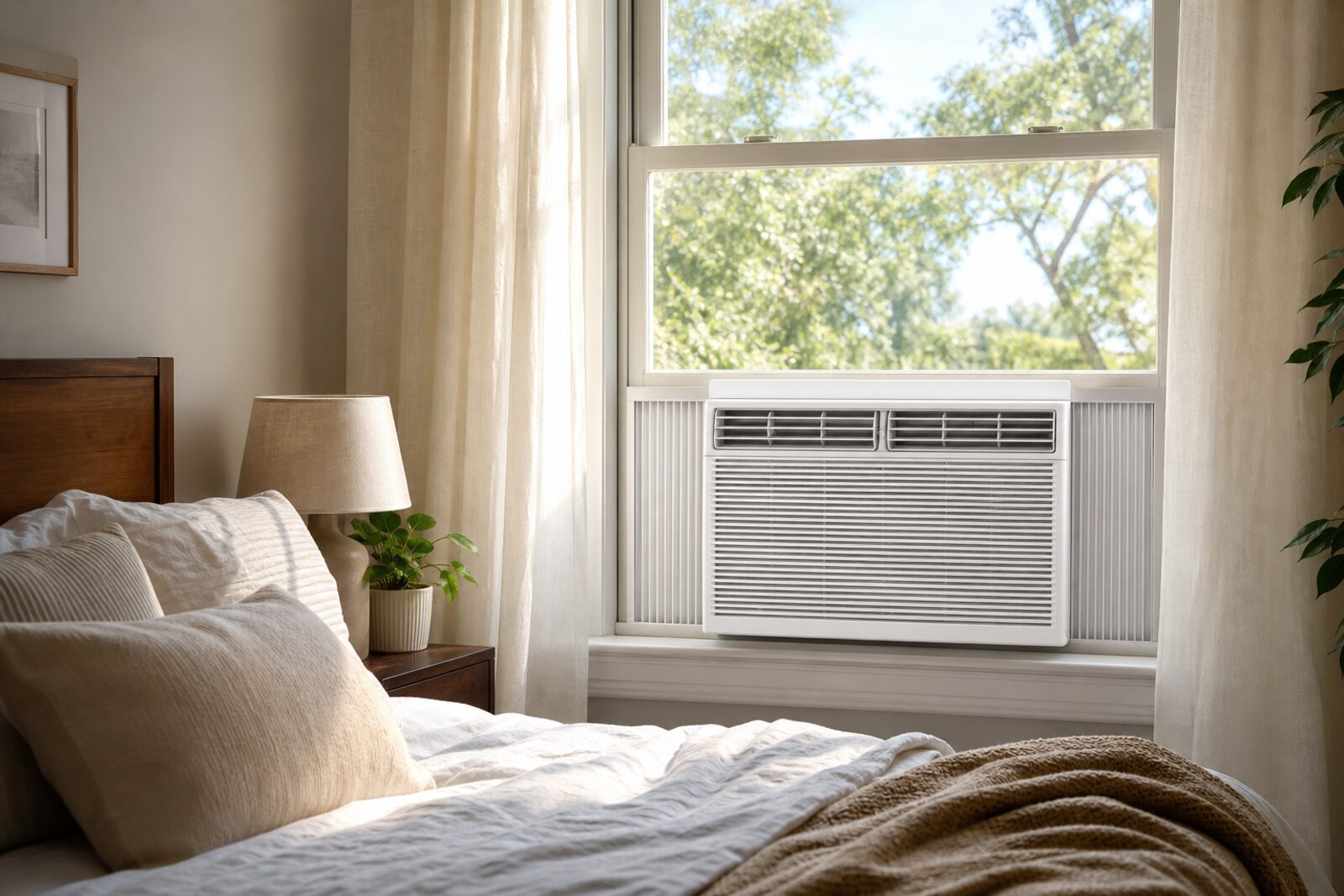
When the bedroom is too hot to sleep in and the central air can't keep the upstairs comfortable, a window air conditioner is usually the fastest, cheapest fix — no ductwork, no contractor, just a few hours with a screwdriver. We compared BTU capacity, noise, install weight, and owner reviews across six widely sold window units to help you match the right one to your room and budget.
- Midea U-Shaped Inverter 8,000 BTU — Best Overall
- LG LW8017ERSM 8,000 BTU — Most Reliable Traditional Design
- GE Profile ClearView 8,000 BTU — Best for Keeping Your View
- Frigidaire FFRE083WAE 8,000 BTU — Best Value for Larger Rooms
- Windmill AC — Quietest
- GE 5,000 BTU Mechanical Window AC — Best Budget
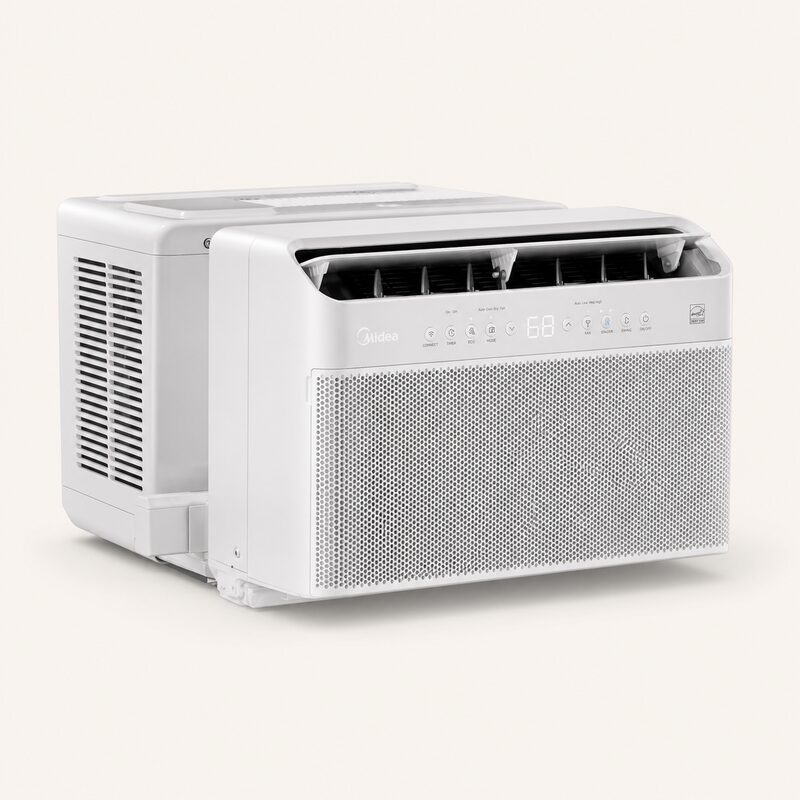
Midea U-Shaped Inverter 8,000 BTU
The Midea U's cutout design is why it keeps landing on best-of lists: the body slides through the window with an open channel down the middle, so the sash closes over the top instead of resting against it. That seals off most of the gaps that let hot air leak in around a standard unit, and lets homeowners lock the window for security — something almost no other model allows.
It's rated for rooms up to about 350 square feet at 8,000 BTU, and the inverter compressor ramps output up and down instead of cycling fully on and off, making it quieter and more efficient than a standard compressor at the same capacity. Expect to pay roughly $370 to $450, with a unit weight around 56 pounds and a 5-year compressor warranty.
- Window can close and lock over the top of the unit
- Inverter compressor is quieter and more efficient than standard units
- Wi-Fi app and voice control on most versions
- Trickier install — needs precise measuring and a helper
- Higher price than comparable standard-compressor units
- Not a fit for windows narrower than about 22 inches
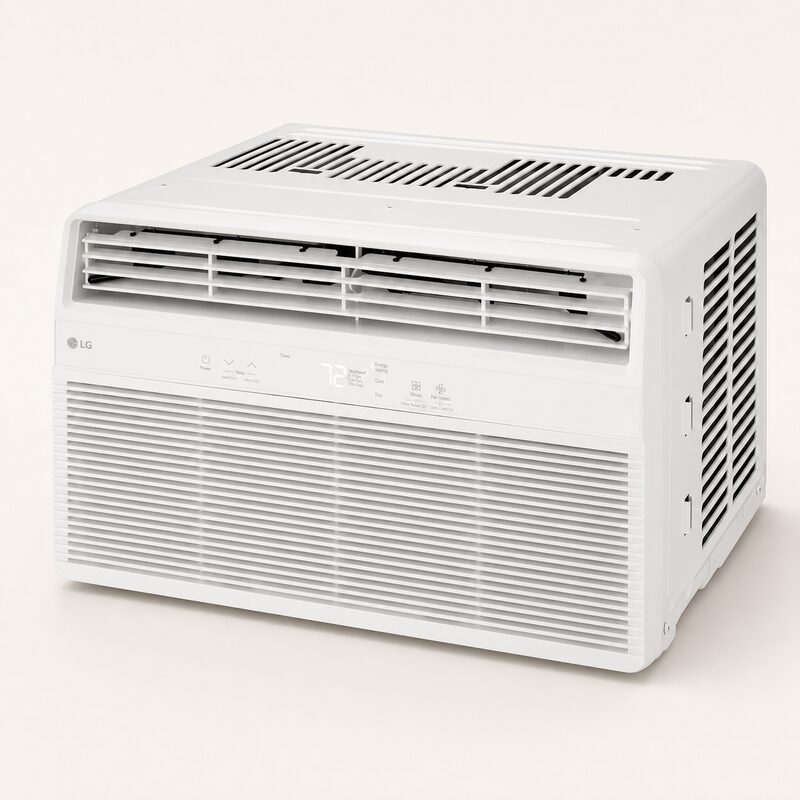
LG LW8017ERSM 8,000 BTU
For anyone who wants a proven design over a newer inverter or app-connected unit, the LG LW8017ERSM is one of the most consistently well-reviewed standard window ACs on the market. It's rated for rooms up to roughly 340 square feet, runs on a standard compressor with three cooling and fan speeds, and includes a remote, a 24-hour timer, and auto-restart after a power blip.
Controls are simple with no app or learning curve, plus a dehumidify-only mode for shoulder-season use. At around 55 pounds, it needs a helper to steady it into a double-hung window, and LG includes an accordion side panel and support bracket in the box. Typical pricing runs $280 to $330.
- Simple, no-app control panel with a genuine remote
- Auto-restart after power outages
- Widely available parts and long track record
- No inverter compressor — cycles on and off rather than modulating
- Noisier than inverter units at the same BTU
- No Wi-Fi or smart home integration
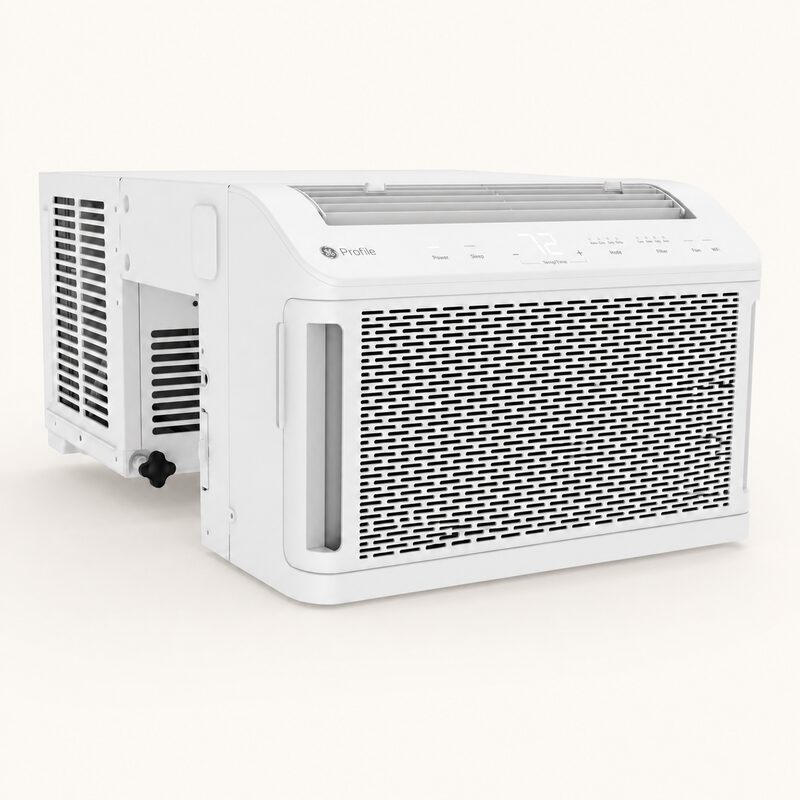
GE Profile ClearView 8,000 BTU
GE's Profile ClearView solves a complaint almost every window AC owner has: the unit blocks the view and dims the room. The cooling assembly sits in the lower portion of the window frame while a clear glass panel occupies the top, so it still looks mostly like a window. It's available in 8,000 and 10,000 BTU, with the 8,000 BTU version suited to rooms around 350 square feet, and connects to GE's SmartHQ app plus Alexa and Google Assistant.
The tradeoff for the glass panel and dual-material cabinet is weight — around 70 pounds — and a higher price than a comparable plain-cabinet unit, typically $450 to $550. Installation also takes longer since the glass panel has to be squared up and sealed carefully.
- Glass panel preserves natural light and outward view
- Wi-Fi scheduling and voice assistant support
- Distinctive design that doesn't look like a typical AC from the street
- Heavier and pricier than a standard 8,000 BTU unit
- Fiddlier installation due to glass panel alignment
- Replacement parts less commonly stocked than standard-unit parts
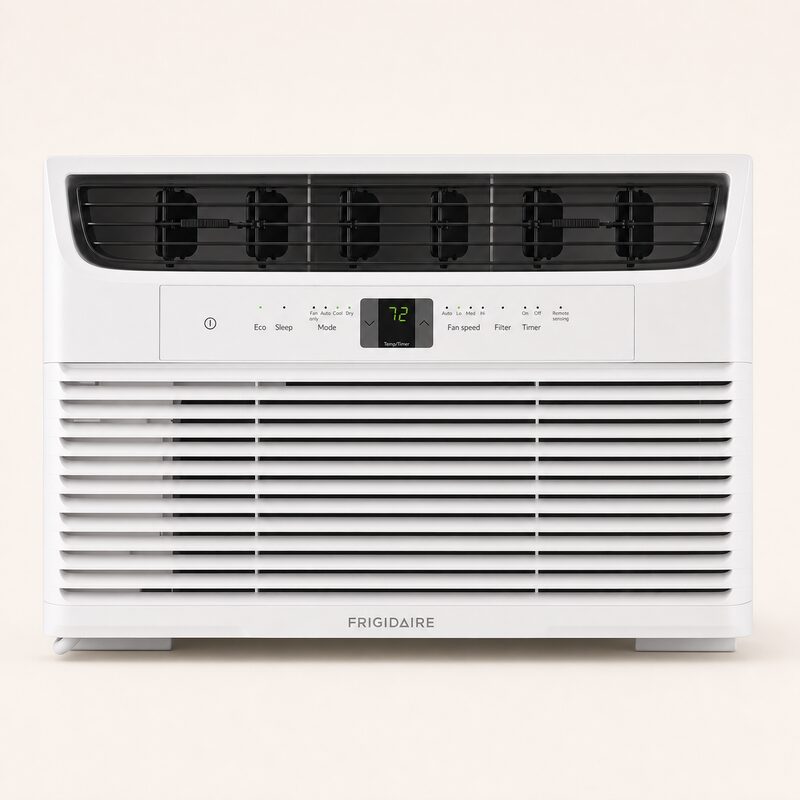
Frigidaire FFRE083WAE 8,000 BTU
The FFRE083WAE is Frigidaire's mid-size window unit, rated for rooms up to about 350 square feet, with electronic controls, a remote, an 8-way air direction louver, and a 24-hour timer. It carries the ENERGY STAR label and uses a standard rotary compressor rather than an inverter, keeping the price down without sacrificing much core cooling performance.
Owner reviews point to Frigidaire's installation kit — foam side panels, a top seal, and a support bracket — as easier to square up than some competitors' accordion panels. It weighs roughly 60 pounds and sells for $260 to $310, among the better cost-per-BTU options here, though it's louder on high than an inverter model of the same capacity.
- Strong price for the BTU capacity and room coverage
- ENERGY STAR certified with straightforward install kit
- 8-way louver spreads airflow better than single-vane units
- Louder and less efficient than the Midea U at the same BTU
- No smart home or app connectivity
- Support bracket reported missing on some units — check on arrival
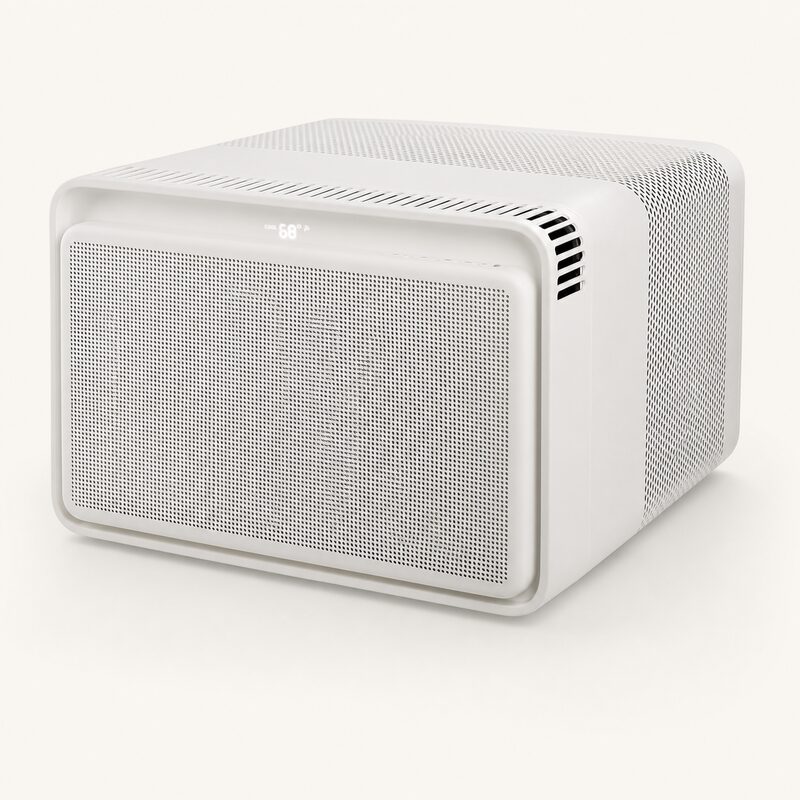
Windmill AC
Windmill built its window AC around renters who care how the unit looks and sounds as much as how cold it gets. At roughly 8,300 BTU, it's sized for rooms up to about 350 square feet, and the rounded, low-profile cabinet with a colored faceplate option is a departure from the boxy look of most window units. It ships with its own tool-free frame kit, designed to seal the window gap more tightly than the foam-and-accordion kits included with standard units.
Windmill's app enables a quiet "eco" mode, with reported sound levels in the low-50s dB range — quieter than most standard-compressor units, though not as low as Midea's inverter on its lowest setting. The unit runs $370 to $470, a premium over Frigidaire or LG, and Windmill also sells a subscription filter service worth factoring into long-term cost.
- Tighter frame kit reduces the drafty, gappy look of a typical install
- Distinct, less industrial appearance for rentals and apartments
- App-based eco/quiet mode scheduling
- Higher price than Frigidaire or LG at similar BTU output
- Filter subscription is an added recurring cost if you opt in
- Smaller company, less long-term repair track record than GE or LG
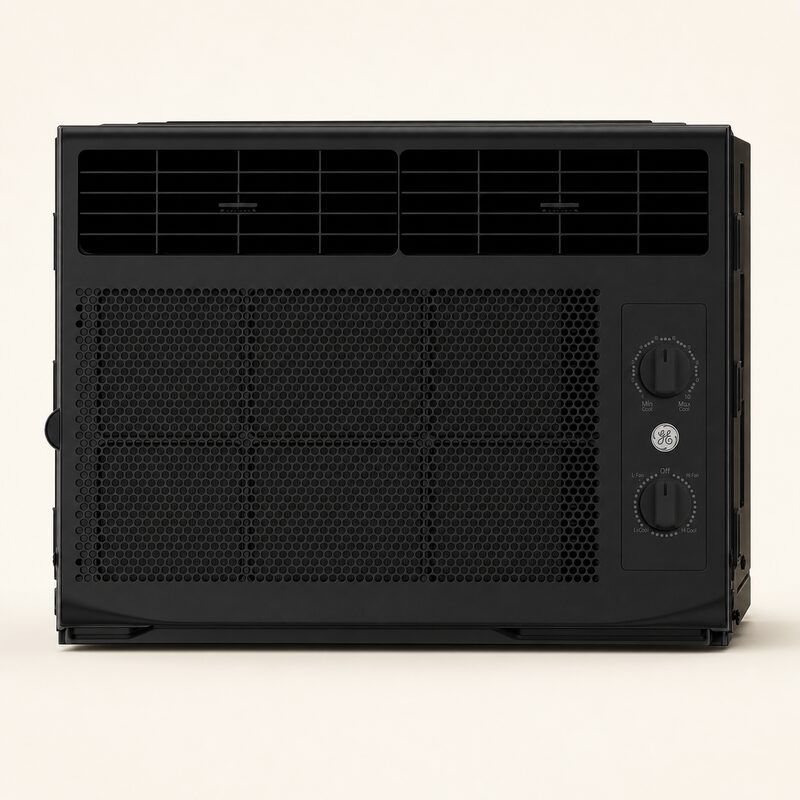
GE 5,000 BTU Mechanical Window AC
Not every room needs 8,000 BTU. GE's 5,000 BTU mechanical window unit is built for small bedrooms, home offices, or nurseries up to roughly 150 square feet, stripping out everything but the cooling itself: a manual rotary dial for temperature and fan speed, two cooling speeds, and no remote or display. That simplicity keeps the price low, typically $180 to $220.
At around 40 pounds, it's light enough for one person to install, fitting standard double-hung windows with the included accordion side panels. Because it cycles on a mechanical thermostat rather than a digital set point, owner reviews describe temperature control as "close enough" but not precise.
- Lowest price and lightest weight on this list
- Simple mechanical controls with nothing to pair or configure
- Easy one-person install
- No remote, timer, or digital display
- Mechanical thermostat is less precise than electronic controls
- Only sized for small rooms — not a fit for anything over about 150 square feet
How to choose a window air conditioner
BTU sizing to square footage
BTU capacity should match your room's square footage: 5,000 BTU covers up to about 150 square feet, 8,000 BTU covers up to about 350, and 10,000 BTU covers up to about 450. High ceilings, west-facing glass, or a nearby kitchen run hotter than the square footage suggests, so size up half a step. Undersized units run constantly without reaching set temperature; oversized ones cool fast without removing humidity, leaving the room clammy.
Inverter efficiency and CEER
Standard compressors cycle fully on and off to hold a temperature. Inverter units, like the Midea U, use a variable-speed compressor that ramps output up and down, using less electricity and less start-stop noise. The efficiency metric on the yellow EnergyGuide label is CEER (Combined Energy Efficiency Ratio) — higher is better, and ENERGY STAR-certified units meet a higher floor than non-certified models of the same BTU.
Noise
Manufacturer decibel ratings are measured on the lowest setting under ideal conditions, so treat them as a comparison point rather than a guarantee. Inverter compressors run meaningfully quieter than standard compressors at the same BTU, especially at night. If noise is the deciding factor for a bedroom, weigh owner reviews that specifically mention nighttime use over the spec sheet's headline number.
Install and window types
Most window ACs fit standard double-hung windows, shipping with adjustable accordion side panels for the gap on either side. Sliding or casement windows, and windows narrower than about 22 inches, typically need a different unit or specialty kit, so check the listed dimensions before buying. Also confirm the sill can support the unit's weight (40 to 70 pounds) and that a support bracket is included.
Drainage
Most units are installed with a slight rear-tilt so condensation drips out the back and evaporates off the hot condenser coil, requiring no drain hose in normal humidity. In very humid climates, or on inverter units running continuously at low speed, some models include a drain port for excess condensation. Check the manual's tilt requirement before mounting — installing a unit level instead of slightly rear-tilted is the most common cause of indoor dripping.
Frequently asked questions
Do I need a support bracket for a window air conditioner?
Most manufacturers require one, since an unsupported sash and sill can eventually sag or crack under the unit's weight. Brackets are inexpensive and either included in the box or sold separately for $15 to $30 — check the listing before assuming it's included.
Is an inverter window AC worth the extra cost?
If the unit runs for long stretches through a hot summer, an inverter model like the Midea U typically earns back some of its price premium in lower electricity use plus quieter bedroom operation. For occasional, seasonal use, a standard-compressor unit like the LG or Frigidaire delivers comparable comfort for less money.
Can I install a window air conditioner myself?
Yes, for most standard double-hung windows, though it's easier and safer with two people — one holding the unit steady, one securing the sash and side panels. Units over about 60 pounds, and any install above the first floor, deserve extra caution or a second set of hands.
How long do window air conditioners typically last?
Most units are built for roughly 8 to 10 years of seasonal use, though continuous use in hot climates shortens that. Compressor failure is the most common end-of-life issue, which is why compressor-specific warranties (5 years on several models here) are worth checking separately from the standard 1-year warranty.
Will a window air conditioner raise my electric bill significantly?
It depends on BTU size, CEER rating, electricity rates, and daily runtime, but an 8,000 BTU ENERGY STAR unit running through a typical summer costs most households roughly $15 to $40 a month, with inverter models at the lower end.
Bottom line
For most homeowners and renters, the Midea U-Shaped Inverter 8,000 BTU is the strongest all-around pick this year — the window-still-closes design, inverter efficiency, and lower noise profile solve the three biggest complaints people have about window air conditioners. Shoppers who want a simpler, no-app unit with a long track record should look at the LG LW8017ERSM instead, and anyone cooling a small bedroom on a tight budget will get solid value from GE's 5,000 BTU mechanical unit.
Our rankings and editorial scores consider product specifications, aggregated owner feedback, availability, drawbacks, and commercial relationships. Compensation may affect inclusion or ordering; scores are our own assessments and are not Amazon or customer ratings. Commercial relationships do not permit unsupported product claims. Read more about how we review.