
If you've heard scratching in the walls after dark, found pepper-flake droppings behind the stove, or noticed your dog suddenly obsessed with the cabinet under the sink, you're dealing with mice — and traps alone won't fix it. Pest control professionals agree on one point above all others: exclusion beats gadgets. A mouse-proof house keeps mice from getting in at all, which matters more than any trap, repeller, or scented oil you can buy after the fact. This guide walks through how to find where mice are entering, how to seal those points correctly, what to remove so your house stops attracting them, which "solutions" are mostly wasted money, and when it's time to bring in a professional.
Find how they're getting in
Before you seal anything, you need to know where the gaps are. Mice don't need much room, and most homes have more potential entry points than owners realize.
The dime-sized-hole rule
A house mouse can squeeze through an opening about the size of a dime — roughly a quarter-inch across — because their skulls are the limiting factor, not their bodies. If you can fit a pencil into a gap, assume a mouse can fit through it too. This is why caulking "the big gaps" isn't enough; the small ones are the ones that matter.
Where to look
Walk the exterior of your house slowly, at ground level, and check these spots specifically:
- Foundation gaps — cracks where the foundation meets the siding, especially at corners and around old settling cracks.
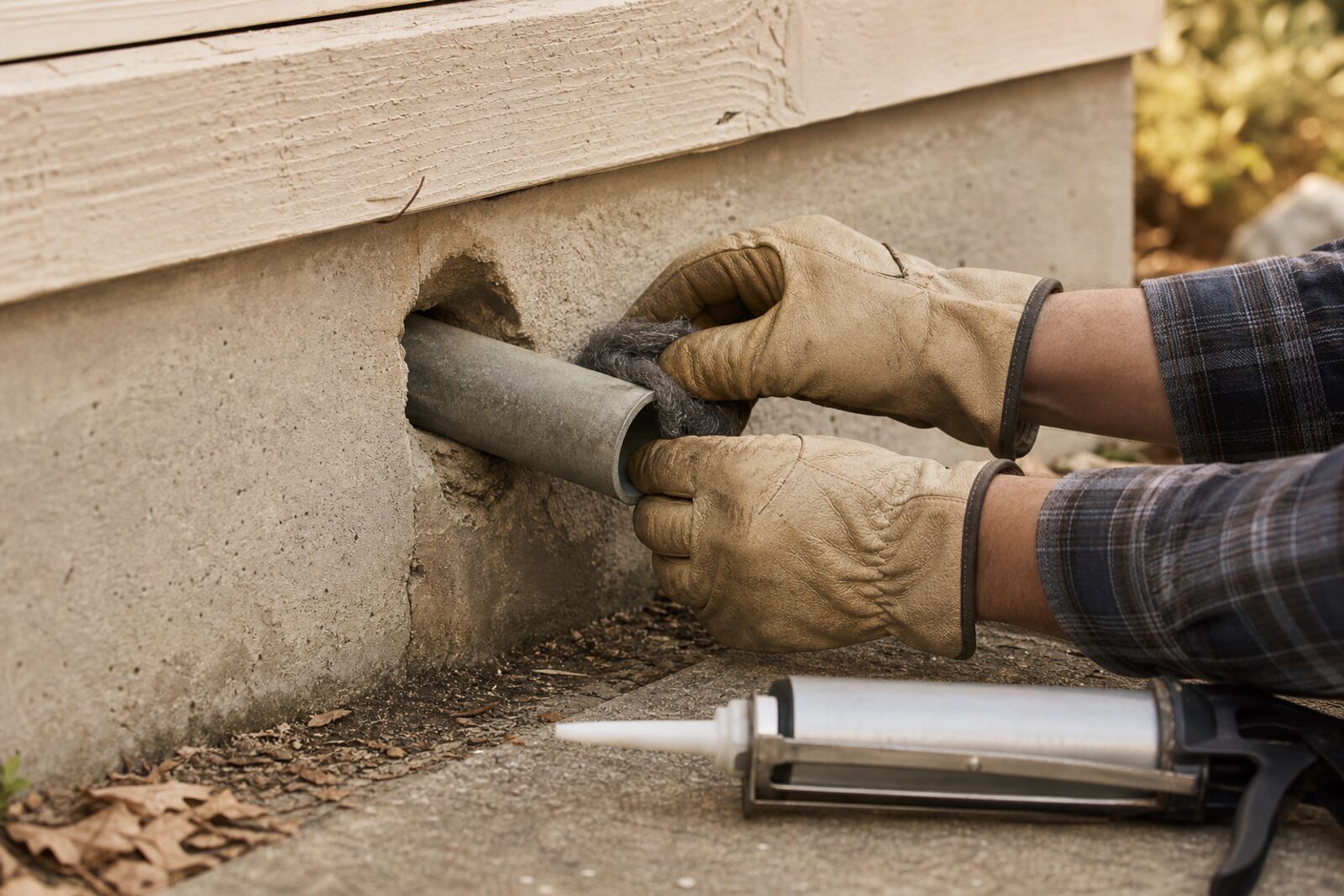
- Utility penetrations — the holes where pipes, gas lines, and cable or phone lines enter the house. Contractors rarely seal these tightly, and the gap around the pipe is often wide enough for a mouse.
- Garage door seals — the rubber strip along the bottom of the door degrades over time and pulls away at the corners, leaving gaps mice use constantly.
- Dryer vents — vents without a working flap, or with a damaged one, are a direct route inside, and the warmth makes them attractive in cold weather.
- Gaps under siding — especially where siding meets the foundation, or around corner boards that have warped or separated slightly.
How to spot rub marks and droppings
Mice travel the same routes repeatedly, and body oil and dirt leave a dark, greasy smudge along walls, baseboards, and beams — usually at a consistent height. Droppings are small, dark, and rice-grain to pepper-flake sized; fresh ones are soft and dark, older ones are dry and gray. Finding either near a wall or opening tells you that's an active route, not just a theoretical one.
Seal the entry points
Once you know where the gaps are, the fix is about using the right material, not just filling the hole with whatever is on hand.
For gaps around pipes, cables, and small foundation cracks, pest professionals recommend stuffing the opening with steel wool, then sealing over it with caulk. The steel wool blocks the mouse from chewing through immediately, and the caulk holds it in place and weatherproofs the joint. Copper mesh works the same way and holds up slightly better outdoors since it won't rust. For larger gaps — a foundation vent, a crawlspace opening, a wider siding gap — hardware cloth (quarter-inch mesh or smaller, screwed or stapled into place) is the better call, since steel wool would just fall out of an opening that size.
On the house itself, install or replace door sweeps on exterior doors, including the one from the garage into the house — that interior door is a common blind spot. On the garage door, replace the bottom seal if it's cracked, flattened, or gapping at the corners; a new seal is inexpensive and takes an afternoon.
One thing worth being direct about: spray foam alone doesn't work. Mice chew through standard expanding foam in minutes, so it has zero deterrent value by itself. If you want foam for a finished, insulated look, apply it over a layer of steel wool or hardware cloth, never as the only barrier.
Remove what attracts them
Sealing the house closes the door, but mice are drawn in by food and shelter, so it helps to remove what's pulling them toward the house in the first place.
Store dry goods — cereal, flour, pet kibble, birdseed — in sealed containers with hard sides, not the original bags or boxes; mice chew through cardboard and thin plastic without effort. Don't leave pet food bowls out overnight, especially outdoors, and pick up spilled kibble around the feeding area. Bird seed stored in the garage is one of the most common attractants homeowners overlook — a torn bag is essentially an open buffet.
Reduce clutter and nesting material — stacks of cardboard, old newspapers, and fabric scraps in basements and garages give mice both shelter and material to build nests. Outside, keep firewood stacked away from the house rather than against the foundation; a woodpile touching the siding is both a highway and a home.
What doesn't really work
It's worth being honest about the products and habits that get recommended constantly but don't hold up.
Ultrasonic repellers — plug-in devices that claim to drive mice away with high-frequency sound — have weak evidence behind them. Independent testing has repeatedly failed to show they reduce mouse activity in real homes, and mice in the wild are routinely found living near constant ambient noise.
Peppermint oil may cause mice to avoid a small area briefly, but the effect fades within days as the scent dissipates or the mice simply adjust. It's not a substitute for sealing entry points.
Mothballs are often suggested as a repellent, but they're both ineffective at real-world concentrations and illegal to use this way — mothballs are registered pesticides, and using them anywhere other than an enclosed, sealed container per the product label is a label violation.
And a lighthearted but real one: getting a cat is not a pest control plan. Some cats hunt mice, plenty don't, and even a good mouser won't stop new mice from entering through an unsealed gap.
When traps and pros come in
Traps have a real role — they're just not a substitute for sealing the house. Once entry points are closed off, traps serve as a backstop for any mice already inside, and they're the most reliable tool for confirming activity has actually stopped. If you're choosing traps, our mouse trap roundup compares the snap, electronic, and live-catch options worth considering.
A few mice getting in occasionally is a nuisance you can usually handle yourself. It becomes an infestation worth escalating when you're seeing mice during the daytime — healthy mice are naturally nocturnal, so daylight sightings usually mean the population has outgrown the available hiding spots — or when there's a persistent, sharp ammonia-like smell from urine buildup in walls or crawlspaces. At that point, a pest-control professional is worth the cost: they can identify entry points a homeowner might miss, use bait stations and monitoring that go beyond consumer traps, and confirm the problem is actually resolved rather than just quieter for a few weeks.
Frequently asked questions
How do I know if I have mice or something else, like rats?
Mouse droppings are small, about the size of a grain of rice, with pointed ends, while rat droppings are noticeably larger and blunter. Mice can also fit through dime-sized gaps, while rats need openings closer to the size of a quarter.
Can mice get in through the roof?
Yes. Gaps where rooflines meet siding, damaged soffit vents, and openings around chimneys are all viable entry points, especially for mice climbing exterior walls or nearby trees.
How long does it take to seal a house completely?
For most homes, a thorough walkthrough of the foundation, utility penetrations, garage, and vents takes a few hours to a full weekend, depending on how many gaps you find.
Will sealing entry points get rid of mice that are already inside?
No. Sealing stops new mice from entering, but any already inside still need to be caught or otherwise removed, which is where traps or a pest-control professional come in.
Do mice come back once a house is properly sealed?
Seals degrade over time — caulk cracks, door sweeps wear down — so an annual check of the same entry points is worth the half hour it takes, particularly before fall.
Bottom line
Mice get into houses through gaps most homeowners never think to check, and no gadget or scent fixes that. Find the openings, seal them with steel wool, copper mesh, or hardware cloth backed by caulk, remove the food and clutter that draws mice in, and use traps as a backstop rather than a first line of defense. Skip the ultrasonic devices and mothballs — they're not doing the job people hope they are. Seal the house properly, and there's a lot less for a trap to catch in the first place.
Our rankings and editorial scores consider product specifications, aggregated owner feedback, availability, drawbacks, and commercial relationships. Compensation may affect inclusion or ordering; scores are our own assessments and are not Amazon or customer ratings. Commercial relationships do not permit unsupported product claims. Read more about how we review.